
The Weekly Reflektion 48/2026
There are many stakeholders involved in the running of a company and all have a say in what the company does and where it is going. The stakeholders may have different interests and objectives so agreement on the issues is often subject to discussions and sometimes disagreements. To progress, a compromise is often reached. Sometimes the compromise is found in what is called the ‘middle ground’. However, this middle ground may turn out to be in wrong place, and things turn out badly.
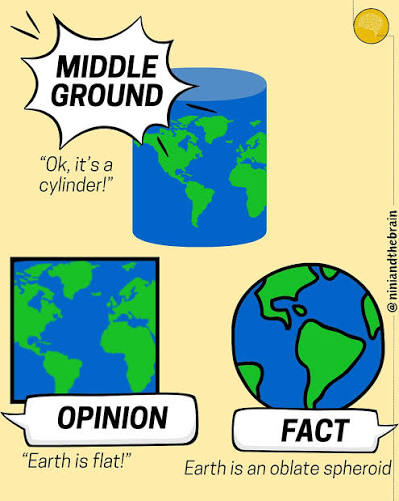
What do end up with when you compromise?
A group of climbers is approaching the summit of a mountain. The weather forecast has deteriorated, and their experienced guide advises turning around. Continuing would expose the group to unacceptable risks. However, one climber strongly objects. He has paid a considerable amount for the expedition, travelled a long distance, and is determined to reach the summit. After some discussion, a compromise is reached. Rather than turning back or continuing to the summit, the group agrees to climb halfway towards the top before descending. Unfortunately, the storm arrives earlier than expected. The climbers become trapped and require rescue. The storm did not care about their compromise.
This illustrates the middle ground fallacy, sometimes called the argument to moderation. It is the mistaken assumption that a position halfway between two opposing views must be reasonable, fair or correct.
Compromise is often essential in human relationships, politics and business. However, when decisions concern physical realities, scientific evidence or major accident risks, compromise does not necessarily produce a better answer. An interesting example comes from research by Maxwell and Jules Boykoff, who examined how American newspapers reported climate change. In their influential 2004 paper, Balance as Bias, they demonstrated how journalistic efforts to present balanced reporting resulted in misleading coverage. Although scientific evidence overwhelmingly supported humaninfluence on climate change, journalists frequently gave comparable attention to opposing views. By treating positions supported by vastly different levels of evidence as equally credible, the reporting created an impression of scientific uncertainty greater than that justified by the available knowledge.
This emphasizes an important point that equal consideration of opinions is not the same as equal consideration of evidence. This point is also prevalent in the post modernistic approach that rejects the idea of a single objective truth, and we will return to this point in future Reflektions.
The implications for major accident prevention may be significant.
In complex situations, initial positions are frequently influenced by experience, commercial pressures, intuition, personal interests and prejudices rather than thorough analysis. When two poorly foundedpositions are negotiated towards a middle ground, the resulting decision has no particular reason to be correct. Indeed, the compromise could fall almost anywhere, depending on the personalities involved, their negotiating skills and their relative authority. In the event that it represents an acceptable solution may be largely a matter of luck.
This is particularly dangerous when commercial considerations are negotiated against technical safety requirements. A cost benefit analysis is employed where risk reduction is assessed against the cost of reducing the risk and a value is assigned to people, the environment and the asset. The subjectivity of the analysis and the complexity of the situation may lead to a compromise and a poor decision. The ‘O’ rings on the Challenger space shuttle in January 1986, the inflow test following cementing of the Macondo well in April 2010, the PSV replacement on Piper Alpha in July 1988, have elements of compromise that influenced the resulting disasters.
Effective major accident prevention requires distinguishing between matters where compromise is appropriate and those where evidence must determine the outcome. Different opinions should be welcomed and challenged, but conclusions must ultimately rest on sound engineering, credible evidence and a proper understanding of risk. The objective of safety and risk discussions should not be to find the middle ground. It should be to find the right answer.