
The Weekly Reflektion 34/2026
Prevention of Major Accidents and improving safety require ambitious and relevant goals, and commitment to pursue these goals. Success is of course related to the targets set and sometimes it may take time. You need then to have faith that the ambition will achieve what you want.
Are you committed enough?
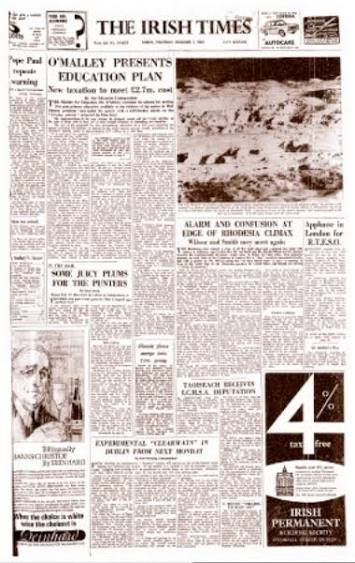
In.September 1966, Ireland was still a relatively poor country. Opportunities for many young people were limited, and emigration remained an important feature of Irish life. Secondary education was not equally accessible and many secondary schools charged fees. This was beyond the reach of poorer families.
The then Minister for Education, Donogh O’Malley, made an extraordinary announcement in a press conference in a hotel in Dun Laoghaire. From the following school year, the state would provide free secondary education. The announcement was unexpected and represented a substantial commitment of public resources. It was not government policy, and O’Malley had not agreed this with his government colleagues. By publicly announcing the objective before all the machinery for delivering it was settled, he effectively changed what was politically possible. Once free education had been publicly promised, the discussion changed from whether it should happen to how it could be delivered. Ireland could not credibly announce free education and subsequently refuse to pay for teachers, schools and transport because these were too expensive. The announcement created an obligation to turn aspiration into practical capability.
The Free Education Scheme began in 1967. Its importance went far beyond removing school fees. It represented an ambitious statement about what Ireland wanted to become. Education was no longer regarded primarily as an opportunity for those whose families could afford it; it became an investment in the future capability of the country. Ireland’s subsequent economic and social transformation had many causes, and it would be wrong to attribute it solely to the 1967 education reforms. Nevertheless, widening access to education helped create the skilled population required by an increasingly modern economy. Research has described the reform as a major change in Irish educational policy and opportunity.
Organizations frequently announce ambitious safety goals: zero accidents, zero major incidents, nobody gets hurt, or everyone goes home safely. Such statements are sometimes criticized as unrealistic. After all, no organization can guarantee that an accident will never occur, but that misses an important purpose of an ambitious goal. A goal establishes an expectation. More importantly, once the expectation has been established, management has made a commitment. The critical question then becomeswhether the management are prepared to provide the resources necessary to live up to it.
A company cannot credibly declare that safety is its highest priority and then repeatedly postpone maintenance, reduce competent staffing, defer replacement of ageing equipment or reject necessary safety improvements because they are too expensive. The words create an expectation. Decisions must subsequently demonstrate that commitment is genuine.
This does not mean that unlimited resources should be spent on every conceivable safety improvement. Safety must still involve rational assessment of hazards, risk and proportionality in risk reduction measures. There is an important difference between challenging how best to achieve a safety objective and quietly abandoning that objective when achieving it becomes inconvenient or expensive.
Ambitious goals can also change the way people think. Before a major change, the existing situation can appear inevitable. Fee-paying secondary education was simply how the system worked in Ireland before 1967. O’Malley challenged that assumption and was the catalyst for change. O’Malley was not an idealist in the context of the commitment to secondary education.
“I’m a realist and I had to deal with the crying needs of our young children who thirst for education so much and so many of whom cannot afford it.”
O’Malley also emphasized that realism is not the same as accepting the status quo.