
The Weekly Reflektion 14/2026
The development of Offshore Wind Power is not a typical subject for Reflekt and our quest for prevention of Major Accidents. It is however an interesting subject to illustrate the continuous battle between facts and scientific analysis, and disinformation. Reality is complicated and sometimes needs to be simplified to get the message across. However, this simplification process is influenced by the interests of the people involved and their prejudices and often ends up as disinformation. Studying the experience of others is often a good way to separate the wheat from the chaff.
Do you learn from others?
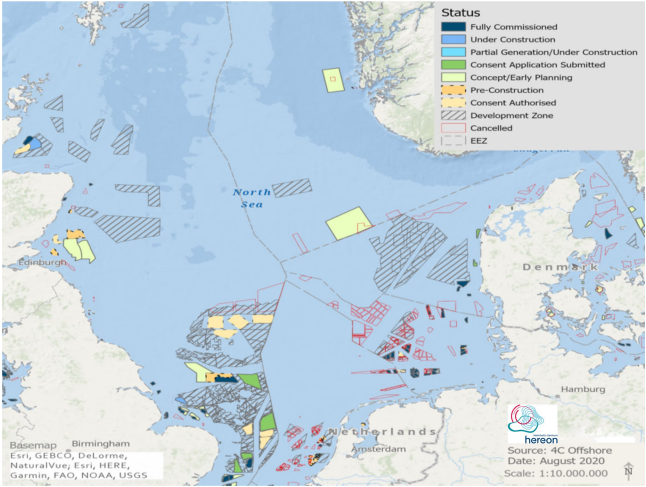
Norway has set an objective of 30 GW of offshore wind capacity by 2040. This is a medium-term goal in the vision for future offshore wind generation. The objective itself, how realistic it is to achieve, and whether there is a need for offshore wind power, are controversial. It is interesting therefore to reflect on the experience of the North Sea, which has now evolved into the world’s largest wind power area.
Offshore wind in the North Sea in the UK, started in the late 20th century, and large-scale development began in the early 2000s. The first offshore turbines in the UK were installed at Blyth in 2000, and the first commercial-scale wind farm was North Hoyle, in 2004. Early projects were relatively small and close to shore, constrained by technological limitations and high costs.
The 2010s marked a transformative phase. Strong policy frameworks such as subsidies, long-term contracts, and planning reforms, enabled rapid expansion. Between 2010 and 2016, UK offshore wind capacity increased roughly sevenfold, while costs fell dramatically due to economies of scale and technological innovation. Turbine sizes increased, installation techniques improved, and supply chains matured.
Denmark, Germany, and the Netherlands also scaled up deployment. By the early 2020s, the North Sea accounted for over 80% of Europe’s offshore wind capacity. Regional cooperation intensified, culminating in agreements such as the 2023 Ostend Declaration, which set targets of 120 GW by 2030 and 300 GW by 2050.
Technological evolution has continued with the shift toward deeper waters and floating wind turbines, enabling expansion into previously inaccessible areas. Grid integration concepts, such as meshed offshore networks and energy islands, are also emerging to efficiently distribute power.
Over the last 20 years, offshore wind has transformed the UK electricity mix. In the mid-2000s, offshore wind contributed only a negligible share of generation. By 2023, offshore wind was producing tens of terawatt-hours annually and supplying a significant share of national electricity, around 15–20% in recent years.
Cost reductions have been equally important. The price of offshore wind electricity in the UK fell by roughly 70% between 2015 and the early 2020s, making it competitive with conventional generation. Latest estimates of levelized cost of electricity (LCOE)indicate that offshore wind power (£90/MWh) is now 40% cheaper than gas-fired power stations (£147/MWh). Note that LCOE is a reasonable comparison factor since it considers net power delivered from the wind turbines, and not the installed capacity.
Offshore wind in the North Sea has shifted from a niche technology to a cornerstone of the UK energy system. Over 20 years, it has enhanced energy security, reduced reliance on fossil fuels, and contributed significantly to decarbonisation goals. Challenges remain. Grid integration, intermittency, environmental impacts, and supply chain constraints must be managed as capacity continues to expand. Despite these issues, offshore wind is expected to play an even larger role, with UK targets of up to 50–60 GW by 2030 and continued regional cooperation in the North Sea.
Some of the challenges with offshore wind generation in Norway are different, but it does look like we could learn a lot from the experience in the UK.