
The Weekly Reflektion 03/2026
Management of change remains one of the most important factors in Major Accident prevention. In some cases, the changes are implemented as a response to another Major Accident and the drive to prevent a recurrence. When changes are rushed and associated risks are poorly assessed then the best intentions can lead to a tragedy. When many changes are made, the cumulative effect of these may reach a point where limits are exceeded. This is why the continuous assessment of overall risk is critical to the safety of any operation.
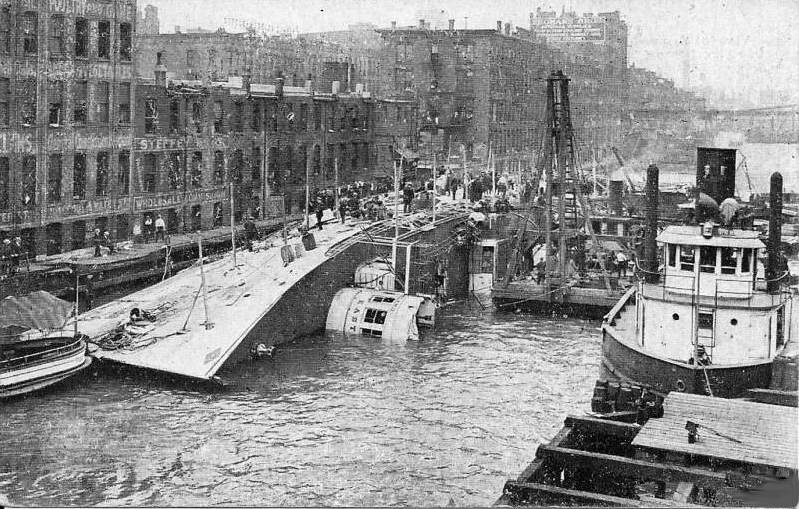
Will the next change you implement be the last straw?
On the morning of July 24, 1915, more than 2,500 excited passengers boarded the excursion steamer SS Eastland on the Chicago River. The occasion was a company picnic organised by the Western Electric Company’s Hawthorne Works in Cicero, Illinois. At 7:28 a.m., SS Eastland listed sharply to port and then rolled completely onto her port side. In less than half an hour, 844 people were dead. Many were trapped below deck in only twenty feet of water.
The SS Eastland was already known to have stability problems and was so top-heavy that she had special restrictions concerning the number of passengers that could be carried. In June 1914, SS Eastland changed ownership when the St. Joseph and Chicago Steamship Company bought the ship. In June 1914 the company removed the old hardwood flooring of the forward dining room on the cabin level and replaced it with 51 mm of concrete. It also added a layer of concrete near the aft gangway. This added 15–20 tons of weight. The federal Seamen’s Act had been passed in 1915 following the RMS Titanic disaster 15th April 1912. The law required retrofitting of a complete set of lifeboats on SS Eastland, as on many other passenger vessels. Due to space restrictions on the ship, these lifeboats were installed high up on the vessel superstructure. The changes were made in isolation, and no comprehensive stability reassessment was made following the increase in top-side weight. The SS Eastland started to list to port when the passengers assembled on the port side to wave to their friends and family standing on the quayside. The proverbial ‘last straw’.
The phrase “the last straw that broke the camel’s back” originates from an ancient Arabic proverb about overloading a camel. It was later adapted into English with variations like “the last feather breaks a horse’s back” by writers like Thomas Fuller and John Bramhall in the 17th century, and by Charles Dickens in the 19th century. It signifies that a seemingly small addition to a series of burdens becomes the final, unbearable trigger for a collapse or breaking point. The point is to illustrate the principle of cumulative effect.
Changes to an operation are often required, for example, to improve performance, increase safety, comply with new regulations and standards, etc. Changes may be technical, operational and/or organisational, and the process to ensure the scope of the changes is understood and managing the risks associated with the changes is a key factor in prevention of unwanted consequences.
The foundation for Reflekt is learning from Major Accidents, and learning requires change, and change requires a management of change (MoC) process that works well. Otherwise, you may end upcapsizing your boat.