
The Weekly Reflektion 42/2026
Effective management of change requires more than approving modifications. It requires understanding the original design limitations, maintaining accurate records and periodically reassessing whether the combined effects of past changes and any new changes remain acceptable.
Do we evaluate the cumulative consequences of individual changes?
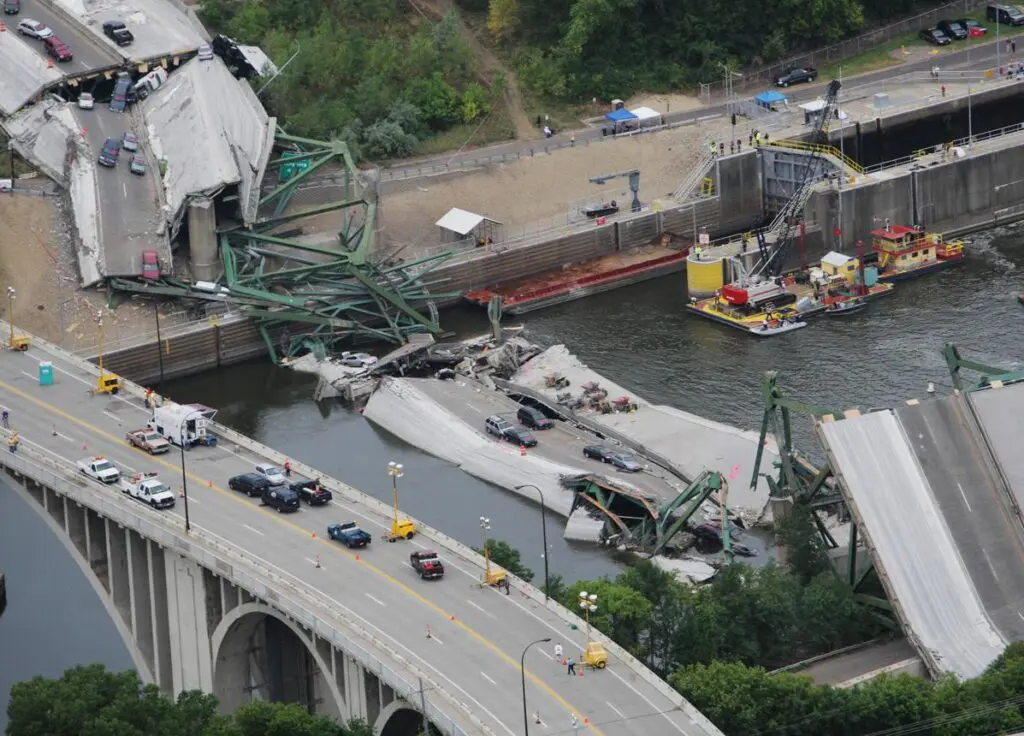
On 1 August 2007, the Interstate 35W highway bridge over the Mississippi River in Minneapolis collapsed into the river 115 feet below, during the evening rush hour. Thirteen people were killed and 145 injured. The bridge had been in service for forty years, carrying thousands of vehicles every day.
The subsequent investigation by the National Transportation Safety Board (NTSB) identified a design error involving steel gusset plates, which connected major structural members of the bridge. These plates were only 0.5 inches thick, half the thickness required to safely support the bridge, hence there was insufficient capacity to carry the loads imposed upon them.
During the bridge’s lifetime, modifications had been carried out that increased its weight. Additional concrete and changes to barriers had placed greater demands on the structure. On the day of the collapse, construction materials and equipment were also stored on the bridge, adding substantial concentrated loads. The combination proved catastrophic.
The bridge had not undergone one individual significant modification that suddenly made it unsafe. Its loading conditions had changed over several decades. Each modification had a purpose, and each may have appeared reasonable when considered individually. But the cumulative effect was an increase in structural loading that the inadequately designed gusset plates could not safely accommodate.
The investigation also revealed that established bridge inspection and load assessment practices had paid insufficient attention to gusset plates. Consequently, an important weakness remained unidentified.
We generally recognise the need for risk assessments when introducing major changes. New equipment, revised procedures and significant modifications normally attract attention.
What happens when the changes are small, separated by years, and managed by different people? This illustrates a fundamental challenge in identifying and managing creeping change.
An additional load is introduced, equipment is upgraded, operating capacity increases, temporary equipment becomes permanent. Each change is considered acceptable, yet the combined effect on the original design assumptions must be reassessed. Eventually, the operation may be very different from the one originally designed for.
When equipment or infrastructure has operated successfully for decades, we have a tendency to assume that it will continue to do so. Yet previous successful operation does not demonstrate that adequate safety margins remain.
The Minneapolis bridge collapse reminds us that the consequences of creeping change may remain hidden until an additional demand exposes an existing weakness. We should regularly ask ourselves if we assessed our equipment, procedures and operations today, would we still consider them acceptable against the assumptions upon which they were originally designed? A series of individually acceptable changes does not necessarily produce an acceptable overall result.
The disaster offers an important lesson in management of change, particularly the danger of assuming that an existing plan, structure, procedure, or organisation can accommodate gradually changing demands without reassessing its original design assumptions.