The Weekly Reflektion 30/2026
The drive for continuous improvement is a key factor in the prevention of Major Accidents however, any improvement requires change and every change has consequences. Sometimes the consequences are not quite as expected. The proverb ‘the way to hell is paved with good intentions’, is an adaption of a quote attributed to the 12th-century abbot Saint Bernard of Clairvaux. He wrote, “Hell is full of good intentions or desires.” The modern phrase evolved over centuries, popularized by English writers like Samuel Johnson.
Will your intentions pave the way to hell?
In the 1950s and early 1960s the World Health Organization (WHO) and other health agencies were trying to eradicate malaria by spraying the insecticide DDT inside homes. One example was in Sarawak, Borneo (now part of Malaysia) and the Dayak people a group of 200 indigenous, Austronesian ethnic groups native to the island. Initially, the program was a success. Mosquito populations crashed and Malaria cases fell dramatically.
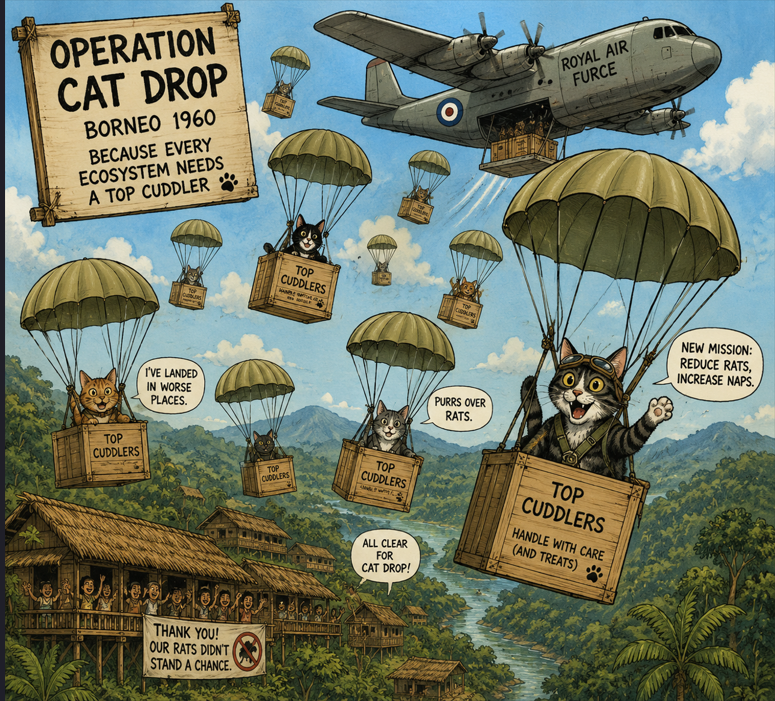
However, the spraying also affected many other species. This led to a chain of unintended consequences. DDT killed mosquitoes (the intended effect). It also killed or severely reduced populations of parasitic wasps that naturally kept thatch-eating caterpillars under control. With fewer wasps, caterpillars multiplied and began eating the grass thatch roofs of the Dayak people’s longhouses. Other insects contaminated with DDT were eaten by geckos. Cats either ate contaminated animals or, more likely according to later research, were directly poisoned by licking DDT from their fur after walking on sprayed surfaces. As cat numbers declined, rats multiplied. The increase in rats raised concerns about diseases such as plague and typhus or other rodent-borne illnesses. This led to Operation Cat Drop when the cats were delivered into isolated settlements that couldn’t easily be reached by road, by the Royal Air Force, who parachuted them down in wicker baskets. Just to emphasize that this was done over a year later, when the DDT was no longer active.
Complex systems can behave in ways that are difficult to predict, meaning that well-intentioned actions can produce unexpected and sometimes catastrophic consequences. These “unintended consequences” arise because engineering systems, organisations and natural environments are interconnected. A change made to improve one aspect of performance may inadvertently weaken another, creating new hazards that are not immediately apparent. For those responsible for safety-critical industries such as nuclear power, aviation, chemical processing and offshore energy, understanding unintended consequences is an essential part of risk management.
The 1986 Chernobyl nuclear disaster illustrates how unintended consequences can arise from a combination of flawed design, inadequate safety culture and poor decision-making. During a planned safety test, operators disabled several automatic protection systems to conduct an experiment under conditions that violated established operating procedures. The intention was to improve understanding of the reactor’s behaviour during a power-loss, but these actions removed important layers of defense. Combined with inherent design weaknesses in the reactor, the test triggered an uncontrollable power surge, resulting in explosions and a massive release of radioactive material. The operators did not intend to cause an accident; rather, a series of seemingly manageable decisions interacted with hidden technical vulnerabilities to produce one of the worst industrial disasters in history.
The consequences extended far beyond the reactor itself. Thousands of people were evacuated, large areas of land became contaminated, and the disaster had profound health, environmental, economic and political impacts that continue to be felt decades later. It also transformed nuclear regulation worldwide, leading to significant improvements in reactor design, emergency preparedness, operator training and international cooperation. Many of today’s nuclear safety standards exist because of lessons learned from Chernobyl’s unintended consequences. Illustrating another key aspect of continual improvement, learning from the disasters that have happened before.